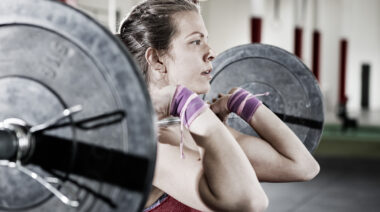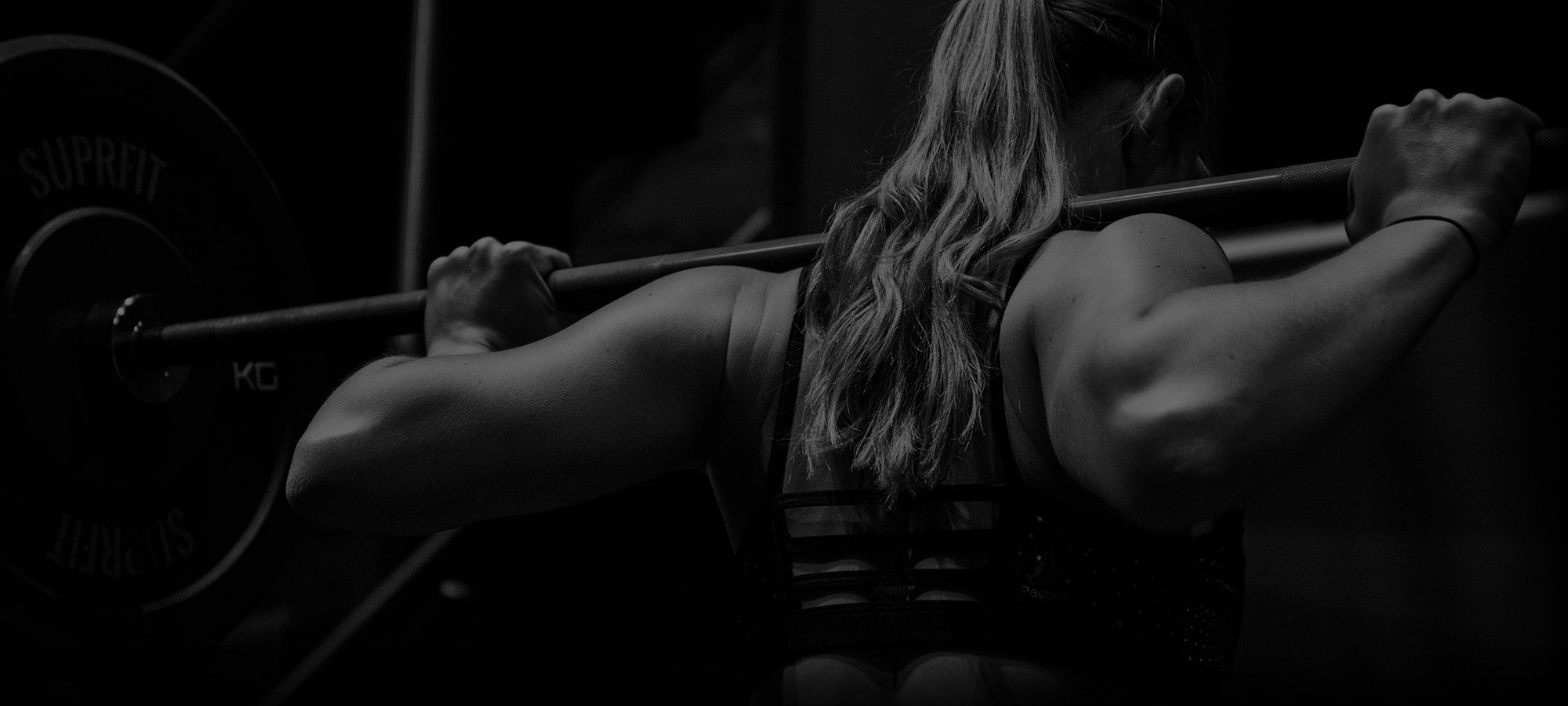

I’ve said it before, and I’ll say it again. The front squat is hands-down my favorite exercise. Whenever I say this, it tends to start a front squat versus back squat debate. Which is crazy, as it’s not an either-or situation.
But I will say that for an athlete who wants to get all-around strong, steer clear of injury, and maximize carry over into strength sports, the front squat offers a number of advantages.
RELATED: Save Your Back by Switching to Front Squats
Why Do Front Squats
In my article When in Doubt, Do Front Squats: 25 Tips for Better Front Squats, I explain:
- From a coaching perspective – Front squats are easier to teach, more self-correcting, and promote better depth.
- From an injury prevention perspective – Front squats are kinder on the shoulders, and incur less shear forces and compressive forces.
- From an athletic perspective – Front squats facilitate awesome core strength and have incredible carry over into other strength movements. This is not just strength-wise, but in terms of position and mechanics, too.
For Olympic weightlifters, the front squat is the best movement for learning the squat clean bottom position. Weightlifting coach Bob Takano explains why in his article Hitting Bottom: 3 Tools to Perfect Your Olympic Lifts:
The best movement for learning the squat clean bottom position is the traditional front squat. This movement performed with an optimal amount of weight will force the body into the bottom position, while simultaneously stretching the tendons and ligaments involved in achieving the position. At this point the front squat is not a strengthening exercise, but a positioning and stretching exercise.
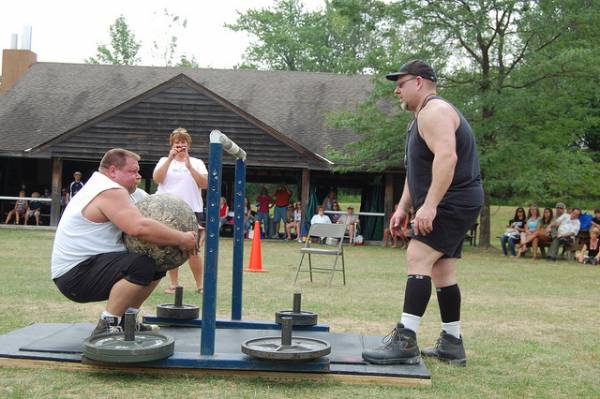
For powerlifters, the front squat can be valuable as an assistance exercise to the back squat. For strongmen, the front squat ties in very well to positions within the sport, such as sitting with a Atlas stone on your lap, ready to drive the stone up and onto the platform (pictured below). For CrossFitters, it also has carryover to other movements within the sport, such as thrusters and wall balls.
So let’s take a deeper look at the movement itself, why you might want to perform it, and variations on the standard barbell front squat.
How to Perform the Front Squat
For those less familiar with this movement, strength and conditioning coach Traver H. Boehm provides a demonstration and basic explanation in his video on the front squat.
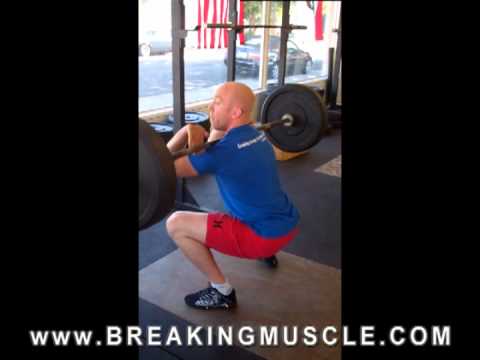
If you prefer a written format, read through this great basic skill review by Breaking Muscle founder, Mindith Rahmat from her article Deconstructing the Front Squat:
- Take time to find your starting position.
- Find your natural foot stance width your feet slightly wider than shoulder width apart and your toes slightly out so your toes can follow the path of your knees.
- Find your grip on the barbell slightly wider than shoulder width.
- Receive the bar from the rack on the front of the shoulders and step back onto the platform.
- Keep chest up and raise the elbows high.
- Stabilize the midline taking in a deep breath.
- Keep the feet flat on the ground pushing down through the heels.
- Squat down until the thighs are below parallel.
- Keep the chest up, back tight, and the elbows high when coming out the squat aggressively drive the elbows up to come out of the hole.
How to Improve the Front Squat
When people ask me how they can improve their front squat, they are disappointed when I don’t reply with something secret and Russian. Rather, I’ll ask to have a look at their front squat. The first place to look for improvement is within the movement, every time.
I’ve written two articles to specifically help you with this. For technical tips on the front squat, check out When in Doubt, Do Front Squats: 25 Tips for Better Front Squats – and I’m only half joking about the “when in doubt do front squats” bit.
“The first place to look for improvement is within the movement, every time.”
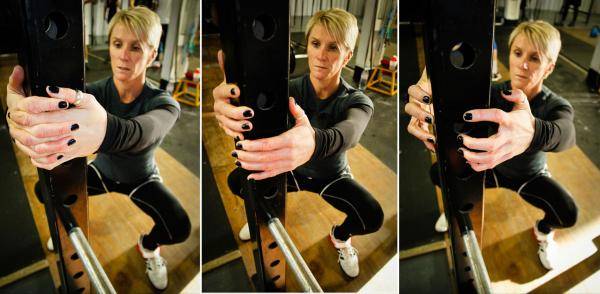
Another way of creating improvement within the movement is to regress the movement down to even simpler forms. In this light, take a look at Squat Therapy: 4 Drills for a Better Squat. Squat therapy will improve your squats through the fact it is formed of four self-correcting movement drills. You are grooving good movement simply by performing the drills.
From regressions, we can move onto variations. Let’s take a look at two variations of the movement, and how they compare to the clean grip barbell front squat.
Crossed Arm Grip
Strength coach Jesse Fernandez explains how this variation works in his article A Primer on Front and Back Squats: Crossed-Arm, Clean Grip, Low Bar, and High Bar:
Place the bar in front of your shoulders, resting it directly on top of your deltoids, just as you with clean grip version. You then will cross your hands over the bar, making an “X” when looked at from up above. Elbows will face forward and arms will be parallel to the ground
Why would you vary the grip? It’s a great question. There is less carryover to the clean with crossed arms. Also it’s not actually that easy to secure the weight like this. However, if you or your client has wrist issues, or other mobility or injury issues restricting hin or her from performing a standard front squat rack, this is a useful way of facilitating the benefits of the front squat without rack position being the limiting factor in terms of weight.
If clean grip was the ultimate goal, then the root causes of the inability to get into a clean grip rack position must be addressed in parallel.
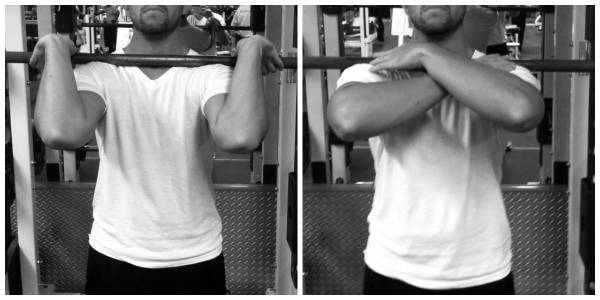
Left: Clean grip; Right: Crossed arm grip.
Two-Kettlebell Front Squat
This is an incredibly humbling movement. Strength and conditioning coach James Cerbie gives us an example of his client’s experiences with this movement in his article The 2-Kettlebell Front Squat: The Best Exercise You’re Not Doing
“Well, that sucked.” My client un-racked the kettlebells and put them on the ground, still contemplating how in the world he got crushed by such little weight (comparatively speaking of course).
Here I was taking this guy who considered himself to be pretty strong (and to his credit he was – he could do a mid-300lb front squat relatively easily), and putting him on the struggle-bus with a pair of 24kg kettlebells.
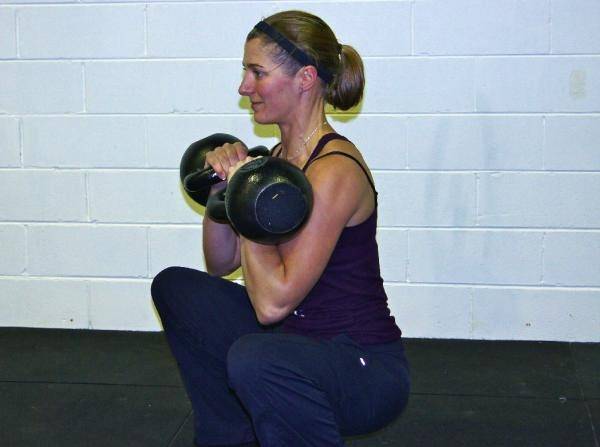
James also lists some key reasons for performing this movement:
- Lower body strength – The increased instability of the kettlebells compensates for the lack of load.
- Core stability – This exercise puts your core on overdrive and forces you to maintain position.
- Grooving the pattern – The previous two points combine to make this movement an effective variation for grooving the squat pattern.
- Breathing into your back – By biasing a little flexion in the bottom of the squat, we can work on good breathing technique.
The article goes on to list how to perform the movement, possible technique flaws, modifications, and even programming – it’s well worth a read.
I hope this article has also been well worth your read. Now, read it again, pick out some points to practice, go do some front squats. Then come come back here and let me know how you got on.
Photo 1 courtesy of CrossFit Empirical.
Photo 2 “Jack Katz Memorial Strong Man Competition” by stu_spivack. Attribution-NonCommercial License.
Photo 3 courtesy of Strength Education.
Photo 4 courtesy of Jesse Fernandez.
Photo 5 courtesy of Read Performance Training.